
About The Human Centipede III (Final Sequence)
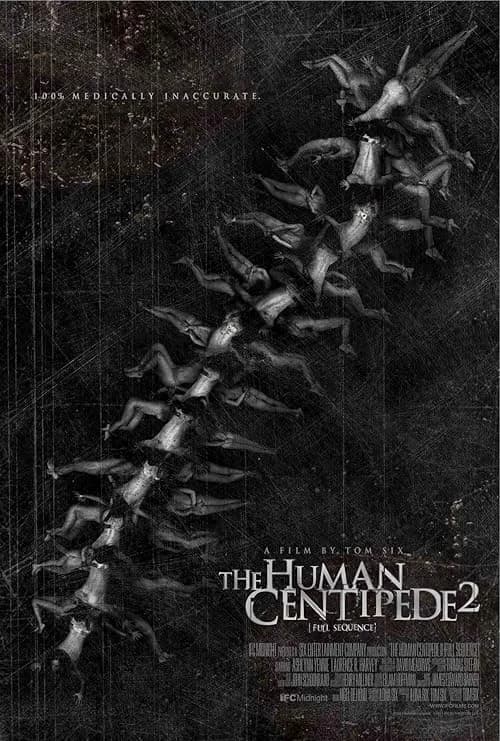
The Human Centipede III (Final Sequence) concludes Tom Six's controversial trilogy with its most audacious and politically charged installment. Set in a chaotic American prison, the film follows sadistic warden Bill Boss (Dieter Laser) and his accountant Dwight Butler (Laurence R. Harvey) as they implement an extreme solution to prison management: surgically connecting 500 inmates into a massive human centipede. What begins as a darkly comedic satire of correctional system failures descends into a grotesque exploration of power, cruelty, and bodily autonomy.
Director Tom Six doubles down on the series' signature shock value while injecting surprising political commentary about mass incarceration and institutional abuse. The performances are deliberately over-the-top, with Laser and Harvey reprising their roles from previous films in new characters, creating a meta-narrative that rewards franchise fans. While the practical effects remain disturbingly convincing, the film leans harder into absurdist comedy than pure horror.
Viewers should watch The Human Centipede III not for traditional horror scares, but as a boundary-pushing exercise in transgressive cinema that questions how far satire can go. The film serves as a fittingly outrageous conclusion to a trilogy that consistently challenged audience limits, making it essential viewing for completionists and those curious about cinema's outer edges. Its 2.7 IMDb rating reflects its divisive nature, but for those seeking uncompromising, conversation-starting horror-comedy, this final sequence delivers unforgettable moments.
Director Tom Six doubles down on the series' signature shock value while injecting surprising political commentary about mass incarceration and institutional abuse. The performances are deliberately over-the-top, with Laser and Harvey reprising their roles from previous films in new characters, creating a meta-narrative that rewards franchise fans. While the practical effects remain disturbingly convincing, the film leans harder into absurdist comedy than pure horror.
Viewers should watch The Human Centipede III not for traditional horror scares, but as a boundary-pushing exercise in transgressive cinema that questions how far satire can go. The film serves as a fittingly outrageous conclusion to a trilogy that consistently challenged audience limits, making it essential viewing for completionists and those curious about cinema's outer edges. Its 2.7 IMDb rating reflects its divisive nature, but for those seeking uncompromising, conversation-starting horror-comedy, this final sequence delivers unforgettable moments.